
Evidence-Based. Clearly Delivered.
Evidence-Based. Clearly Delivered.

Jennifer A. Doudna and Emmanuelle Charpentier were awarded the 2020 Nobel Prize for Chemistry for their discovery of a technology, described by the Nobel Committee as “Genetic scissors: a tool for rewriting the code of life”. CRISPR (a wisely chosen acronym for Clustered Regularly Interspaced Short Palindromic Repeats) in combination with the enzyme Cas9 (CRISPR-associated protein 9), is a new breakthrough technology that can target a section of DNA, literally cut out a sequence of interest and insert a new sequence in its stead that is then incorporated during the process of DNA repair. There is no doubt that CRISPR/Cas9 represents a watershed moment in science, and applications for therapeutics and even cures of disorders once thought incurable are on the horizon. The Nobel Committee appropriately describes CRISPR as a “technology has had a revolutionary impact on the life sciences, is contributing to new cancer therapies and may make the dream of curing inherited diseases come true.”
In a publication by Ma et al. (Nature, 2017), researchers were able to take human preimplantation embryos and cut out and replace a disease-causing pathogenic variant, using the CRISPR/Cas9 gene-editing tool.
In anticipation of a fast-paced research trajectory, The American Society of Human Genetics (ASHG) brought together an international workgroup that included representatives from the following organizations
The document was endorsed by
The following positions are stated in this document:
(1) At this time, given the nature and number of unanswered scientific, ethical, and policy questions, it is inappropriate to perform germline gene editing that culminates in human pregnancy. (2) Currently, there is no reason to prohibit in vitro germline genome editing on human embryos and gametes, with appropriate oversight and consent from donors, to facilitate research on the possible future clinical applications of gene editing. (3) There should be no prohibition on making public funds available to support this research. (4) Future clinical application of human germline genome editing should not proceed unless, at a minimum, there is (a) a compelling medical rationale, (b) an evidence base that supports its clinical use, (c) an ethical justification, and (d) a transparent public process to solicit and incorporate stakeholder input.
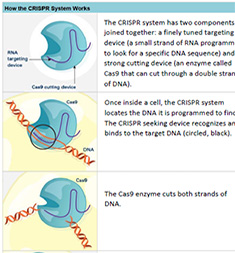
CRISPR/Cas9 NIH Graphic (Credit: NIH)
The ObG Project highly recommends you join the almost 2-million people who have viewed Dr. Jennifer Doudna’s TED talk. As a co-inventor of CRISPR/Cas9, she explains this groundbreaking technology in less than 20 minutes and makes the case for why this research must be done within an ethical framework.
How CRISPR lets us edit our DNA | Jennifer Doudna
Correction of a pathogenic gene mutation in human embryos
ASHG Position Statement: Human Germline Genome Editing
Review: Development and Applications of CRISPR-Cas9 for Genome Engineering
Review: CRISPR-Based Technologies for the Manipulation of Eukaryotic Genomes
Development of CRISPR as an Antiviral Strategy to Combat SARS-CoV-2 and Influenza
Nobel Prize in Chemistry Announcement 2020
The contents of this Site, such as text, graphics, images, information obtained from The ObG Project’s licensors, and other material contained on the Site (“Content”) are for informational purposes only. The Content is not intended to be a substitute for professional legal or medical advice, diagnosis, or treatment. Always seek the advice of your physician or other qualified health provider with any questions you may have regarding a medical condition. Never disregard professional medical advice or delay in seeking it because of information you have read on the Site!
If you think you may have a medical emergency, call your doctor or 911 immediately. The ObG Project does not recommend or endorse any specific tests, physicians, products, procedures, opinions, or other information that may be mentioned on the Site. Reliance on any information provided by The ObG Project, The ObG Project employees, others appearing on the Site at the invitation of The ObG Project, or other visitors to the Site is solely at your own risk.
The Site may contain health- or medical-related materials that are sexually explicit. If you find these materials offensive, you may not want to use our Site.
Children’s Privacy
We are committed to protecting the privacy of children. You should be aware that this Site is not intended or designed to attract children under the age of 13. We do not collect personally identifiable information from any child we reasonably believe is under the age of 13.
Exclusive Features:
Exclusive Features:
OBG Project CME requires a modern web browser (Internet Explorer 10+, Mozilla Firefox, Apple Safari, Google Chrome, Microsoft Edge). Certain educational activities may require additional software to view multimedia, presentation, or printable versions of their content. These activities will be marked as such and will provide links to the required software. That software may be: Adobe Flash, Apple QuickTime, Adobe Acrobat, Microsoft PowerPoint, Windows Media Player, or Real Networks Real One Player.
This educational activity may contain discussion of published and/or investigational uses of agents that are not indicated by the FDA. The planners of this activity do not recommend the use of any agent outside of the labeled indications.
The opinions expressed in the educational activity are those of the faculty and do not necessarily represent the views of the planners. Please refer to the official prescribing information for each product for discussion of approved indications, contraindications, and warnings.
Participants have an implied responsibility to use the newly acquired information to enhance patient outcomes and their own professional development. The information
presented in this activity is not meant to serve as a guideline for patient management. Any procedures, medications, or other courses of diagnosis or treatment discussed or suggested in this activity should not be used by clinicians without evaluation of their patient’s conditions and possible contraindications and/or dangers in use, review of any applicable manufacturer’s product information, and comparison with recommendations of other authorities.
Jointly provided by